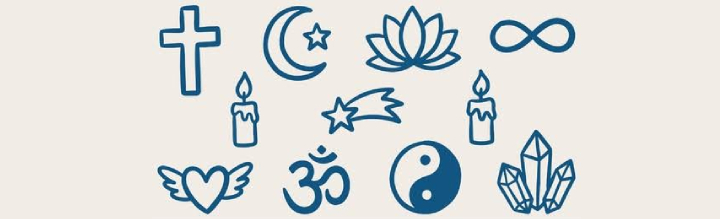
Long before written language, people were telling stories through symbols. Circles were carved into stone. Spirals appeared in ancient art. Sacred buildings were aligned with stars. Patterns emerged across cultures that never met one another yet somehow arrived at surprisingly similar ways of expressing meaning. Even today, symbols remain deeply woven into human experience. We wear them, draw them, dream about them and attach meaning to them. A circle may represent wholeness. A doorway may represent transformation. Certain numbers feel significant. Certain patterns seem to speak to something beyond words. But why?
Why do humans continue creating meaning through shapes, symbols and repeating forms? From a spiritual perspective, symbols can be understood as bridges between inner experience and outer expression. From a psychological perspective, they may reflect how the mind naturally organises meaning. Whatever perspective you take, symbols continue to shape the way we understand ourselves and the world.
What Makes a Symbol Different From an Object?
A symbol is more than what it physically appears to be. It points beyond itself. For example:
• A candle may symbolise hope or presence
• A circle may symbolise unity or completion
• Water may represent renewal or emotion
• A path may represent growth or life direction
Symbols help express experiences that are difficult to explain directly. This is one reason symbols appear so often in spiritual traditions. Some experiences are felt more easily than they are described.
Why Humans Create Symbols
Humans are meaning-making beings. We naturally look for connection between experiences. Symbols help us:
• Organise complex ideas
• Communicate emotional experiences
• Express spiritual beliefs
• Create identity and belonging
• Understand change and transformation
Long before scientific language existed, symbols helped people make sense of mystery. And in many ways, they still do.
The Circle: One of Humanity’s Oldest Sacred Symbols
Across cultures and time periods, the circle appears repeatedly. Spiritually, circles are often associated with:
• Wholeness
• Unity
• Continuity
• Cycles of life
• Completion
Examples appear everywhere:
• The sun and moon
• Mandalas
• Sacred architecture
• Ceremonial spaces
• Wedding rings
Unlike shapes with clear beginnings and endings, the circle suggests movement without separation. It reflects one of the oldest human observations: Life moves in cycles.
Spirals: Symbols of Growth and Transformation
The spiral is another ancient pattern found across many traditions. Spirals appear in:
• Ancient stone carvings
• Sacred art
• Nature
• Spiritual imagery
The spiral is often interpreted as representing:
• Expansion
• Evolution
• Inner growth
• Returning to familiar places with greater awareness
Unlike a circle, which returns to the same point, a spiral suggests movement and development. Spiritually, this can feel deeply relatable. Many life lessons do not happen once. We revisit them at different levels of understanding.
Triangles: Balance and Direction
Triangles appear repeatedly in spiritual and symbolic systems. They are often connected to:
• Stability
• Transformation
• Integration
• Connection between different dimensions of experience
Different traditions interpret triangles differently, but common themes include:
• Mind, body and spirit
• Beginning, middle and end
• Past, present and future
The upward-pointing triangle is often associated with movement, aspiration or expansion. Its structure creates a natural sense of direction.
Why Numbers Become Symbolic
Numbers are practical but they have also carried symbolic meaning throughout history. Many spiritual systems assign significance to numbers.
Examples include: One – Often associated with:
• Unity
• Origin
• Wholeness
Three – Commonly connected to:
• Creation
• Balance
• Transformation
Four – Often linked to:
• Stability
• Foundations
• Natural order
Seven – Historically connected with:
• Reflection
• Completion
• Spiritual significance
Even people who do not identify as spiritual often notice patterns involving numbers and wonder whether they feel meaningful. This reveals something interesting: Humans naturally seek meaning in repetition.
Sacred Geometry: When Pattern Becomes Symbol
Sacred geometry refers to symbolic and philosophical interpretations of geometric forms. Across history, geometric patterns have appeared in:
• Architecture
• Religious spaces
• Art
• Nature-based traditions
Examples include:
• Symmetry
• Interconnected circles
• Geometric repetition
• Proportional design
Many traditions viewed these patterns as expressions of harmony and order. Today, people often find these designs calming or visually satisfying. Whether interpreted spiritually or aesthetically, pattern affects experience.
Symbols in Nature
Many symbolic traditions draw inspiration directly from the natural world. Examples include:
Trees:
• Growth
• Connection
• Stability
Mountains:
• Perspective
• Challenge
• Elevation
Water:
• Emotion
• Change
• Renewal
Seasons:
• Cycles
• Transformation
• Renewal
Nature became one of humanity’s earliest symbolic languages. It offered visible examples of invisible experiences.
Carl Jung and the Language of Symbols
Psychologist Carl Jung believed symbols played an important role in understanding the human experience.
He explored the idea that certain symbolic themes appear repeatedly across cultures. These recurring patterns became known as archetypes. Examples include:
• The journey
• The guide
• The transformation
• The shadow
• The homecoming
Jung suggested that symbols connect conscious awareness with deeper layers of the psyche. This may explain why symbolic experiences often feel emotionally powerful.
Why Symbols Still Matter Today
Modern life often prioritises logic and measurable outcomes. Yet symbols remain everywhere. We still use:
• Wedding rings
• National flags
• Logos
• Ceremonies
• Rituals
• Personal objects with emotional meaning
People continue assigning meaning to experiences because symbols help connect information with emotion. Even personal habits become symbolic. A morning cup of tea can represent calm. A walk can represent release. A journal can represent reflection. Symbols remain part of everyday life.
The Difference Between Meaning and Certainty
Symbols become most helpful when they invite reflection rather than rigid interpretation. A symbol does not have one universal meaning. The same image may represent different things to different people. For example:
A bridge may mean:
• Transition
• Opportunity
• Leaving something behind
• Moving toward something new
Context matters. Personal experience matters. The value of symbols is often found in what they awaken rather than what they prove.
Creating Your Own Symbolic Awareness
You do not need specialised knowledge to explore symbolism. Start by becoming curious. Notice:
• What shapes or images draw your attention?
• What patterns repeat in your life?
• What places feel meaningful?
• What objects carry emotional significance?
You may discover that symbolism is already present in your daily experience. Not as hidden messages. But as reflections of what matters to you.
Ritual and Symbol in Everyday Life
Simple symbolic practices can create moments of awareness. For example:
• Lighting a candle to mark intention
• Writing something down and letting it go
• Walking intentionally at the end of the day
• Rearranging a space during periods of change
These actions are not magical solutions. They create moments where inner experience becomes visible. That visibility itself can feel meaningful.
A Final Thought
Throughout history, humans have continued creating meaning through shapes, numbers and patterns. Not because symbols replace reality, but because they help us engage with it more deeply. Symbols allow us to express what feels difficult to explain. They connect thought with emotion, inner life with outer experience. Whether found in ancient traditions, modern rituals, nature or personal reflection, symbols remain part of how we understand transformation, connection and meaning.
Perhaps the reason symbols endure is simple: Some truths are not always meant to be explained.
Sometimes they are meant to be experienced.

Author: Spirit Connection
Welcome to Spirit Connection, your online sanctuary for spiritual growth, enlightenment, and transformation. Founded by me, Glynis Brits - a gifted clairvoyant medium, spiritual teacher, and life coach, my mission is to guide you on a journey of self-discovery, healing, and deeper connection with the spiritual realm. Here at Spirit Connection, I publish daily articles on all things spiritual, esoteric, and metaphysical, offering insights and wisdom to support your awakening. Whether you're looking to connect with your spirit guides, enhance your intuition, or explore the mysteries of the universe, I provide the tools and knowledge to help you navigate your path. Through private readings, spiritual coaching, and personalized guidance, I empower individuals to embrace their divine potential and align with their soul’s purpose. Whether you're seeking clarity, healing, or a deeper understanding of your spiritual journey, I am here to support you every step of the way. Join my community and awaken to the magic of the unseen world. Your journey to enlightenment starts here.