Have you ever caught yourself thinking:
“I’m just not good enough.”
“I’m not the kind of person who succeeds.”
“People always leave eventually.”
“I could never do something like that.”
“It’s too late for me to change.”
We all carry stories about ourselves and the world around us. Some of these stories support us, while others quietly restrict what we believe is possible.
These are often called limiting beliefs.
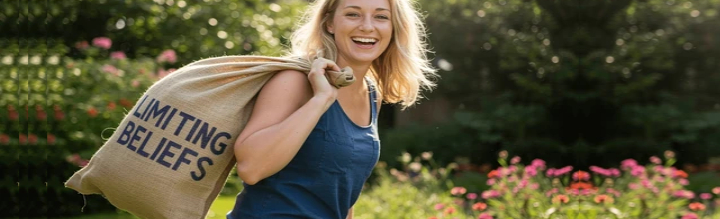
A limiting belief is a deeply held assumption about yourself, other people or life that may restrict the way you think, feel or behave. It can feel like a simple fact rather than a belief.
But there is an important difference between saying:
“I can’t do this.”
and asking:
“What makes me believe I can’t?”
That small shift can open the door to profound self-awareness.
Where Do Limiting Beliefs Come From?
Most limiting beliefs don’t appear from nowhere.
They can develop through childhood experiences, family messages, cultural expectations, difficult relationships, criticism, rejection, failure or experiences that left a strong emotional impression.
Imagine a child who repeatedly hears:
“You’re too sensitive.”
Over time, that child may begin to believe that their emotions are a problem.
As an adult, they might struggle to express their needs, dismiss their own feelings or feel ashamed when something affects them deeply.
The original message may have been spoken many years ago, but the belief can continue influencing behaviour long after the person has forgotten where it began.
This is one reason self-awareness matters.
Sometimes what feels like “just the way I am” is actually a pattern that was learnt.
A Belief Is Not Necessarily a Fact
One of the most powerful questions you can ask yourself is:
“Is this actually true?”
This doesn’t mean pretending that every difficulty is easy to overcome.
There are genuine limitations in life. We have circumstances, responsibilities, physical realities and other factors we cannot simply think our way out of.
But many of the conclusions we make about ourselves are interpretations rather than objective facts.
For example:
“I failed, therefore I’m a failure.”
The first part describes an event.
The second part turns the event into an identity.
You can fail at something without being a failure.
You can experience rejection without being unworthy of love.
You can struggle with something without being incapable.
You can make a mistake without becoming your mistake.
Learning to distinguish what happened from the story you created about what happened can be incredibly freeing.
How Limiting Beliefs Shape Our Behaviour
Beliefs can influence what we notice, what we attempt and how we respond when things don’t go according to plan.
Imagine someone who believes:
“I’m not confident enough to speak in front of people.”
They may avoid opportunities to speak.
Because they avoid them, they get less practice.
Because they get less practice, speaking remains uncomfortable.
The discomfort then appears to confirm the original belief.
A cycle develops.
The belief influences the behaviour, and the behaviour provides apparent evidence for the belief.
This is why changing a limiting belief isn’t always about simply repeating a positive statement.
Sometimes we need to change the behaviour that keeps reinforcing the belief.
Small experiences of doing something differently can gradually provide new evidence.
The Difference Between a Limiting Belief and Humility
There is an important distinction here.
Not every negative statement about ourselves is a limiting belief, and not every positive statement is healthy.
For example, recognising:
“I don’t know how to do this yet.”
can be honest and useful.
Saying:
“I could never learn this.”
is very different.
The first acknowledges a current skill level.
The second turns a temporary situation into a permanent identity.
Healthy self-awareness isn’t about convincing yourself that you’re perfect or capable of absolutely everything.
It is about seeing yourself accurately, while remaining open to growth.
Listen to Your Inner Dialogue
One of the easiest ways to discover limiting beliefs is to listen to the way you speak to yourself.
For a few days, notice what happens inside your mind when something goes wrong.
Do you say:
“I’m so stupid.”
“I always mess things up.”
“Why can’t I be like everyone else?”
“Nobody really wants me around.”
“I’ll probably fail anyway.”
These statements can become so familiar that we barely notice them.
Try treating your inner dialogue as information rather than truth.
You don’t have to fight every thought.
Simply notice it.
Then ask:
“Would I speak to someone I love in this way?”
If the answer is no, there may be an opportunity to develop a kinder inner relationship.
What Are You Afraid Would Happen?
Sometimes a limiting belief protects something underneath it.
Consider the belief:
“I shouldn’t put myself out there.”
What might be underneath it?
Perhaps:
“People might judge me.”
And underneath that:
“If they judge me, I’ll feel rejected.”
And perhaps underneath that:
“If I’m rejected, it will mean I’m not good enough.”
The belief may therefore be connected to a deeper fear.
This is why changing the surface thought isn’t always enough.
Ask:
“What am I afraid this belief protects me from?”
The answer can reveal something important.
Challenging a Limiting Belief
When you identify a belief that may be restricting you, try working through these questions:
- What is the belief?
Write it down exactly as you think it.
For example:
“I’m not capable of succeeding.”
- Where might it have come from?
Was it connected to a particular experience, relationship or repeated message?
You don’t need to find one perfect explanation. Simply explore.
- What evidence supports it?
Be honest.
Are there experiences that genuinely contribute to this belief?
- What evidence doesn’t support it?
Look for exceptions.
Have there been times when you succeeded, persisted, learnt something difficult or surprised yourself?
- Is there another way of interpreting the situation?
Instead of:
“I always fail.”
perhaps:
“I’ve experienced failures, but I’ve also learnt and improved.”
- What would I do differently if I didn’t believe this?
This is often the most revealing question.
Imagine the belief wasn’t controlling your choices.
What would you try?
Who would you speak to?
What boundary might you set?
What opportunity might you accept?
From Positive Thinking to Conscious Thinking
There is a temptation to replace every negative belief with an extremely positive statement.
For some people, saying “I am completely confident and successful” when they don’t believe it can actually feel disconnected from reality.
A more grounded approach is to create statements that are both compassionate and believable.
Instead of:
“I am fearless.”
try:
“I can learn to respond to fear without allowing it to make every decision for me.”
Instead of:
“Nothing can stop me.”
try:
“I can take the next step, even when I don’t know exactly how everything will work out.”
Instead of:
“Everyone will love me.”
try:
“I don’t need everyone’s approval to know my own worth.”
The goal isn’t to create a fantasy.
It is to create a more balanced relationship with yourself.
Limiting Beliefs and Spiritual Growth
From a spiritual perspective, limiting beliefs can be particularly interesting because they invite us to question the identity we have constructed.
We often say:
“I am this.”
“I am that.”
“This is just who I am.”
But who is the “I” behind these statements?
This connects with our earlier exploration of consciousness and the difference between awareness and the stories passing through the mind.
A belief can be deeply familiar without being the whole truth of who you are.
Some spiritual traditions encourage people to look beyond conditioned identity towards a deeper sense of self, awareness or inner being.
You don’t have to accept any particular spiritual interpretation.
You can simply explore the question:
“Who am I beneath the stories I have learnt about myself?”
You Don’t Have to Fight Your Old Beliefs
When people discover limiting beliefs, they sometimes become frustrated with themselves.
“Why am I still thinking this way?”
But remember: many of these patterns developed for a reason.
Perhaps a belief once helped you feel safe.
Perhaps avoiding rejection protected you from disappointment.
Perhaps staying small helped you avoid criticism.
Perhaps perfectionism gave you a sense of control.
You don’t have to attack these parts of yourself.
You can thank them for trying to protect you while recognising that you may no longer need the same strategy.
This is where self-compassion becomes important.
Healing isn’t necessarily about destroying old parts of yourself.
It can be about understanding them and choosing a new way forward.
A Simple Daily Practice
At the end of each day, take five minutes to write down one moment when you experienced a strong emotional reaction.
Then ask:
What happened?
What did I feel?
What did I tell myself about what happened?
What belief might be underneath that story?
Is there another possible interpretation?
What would I like to believe or practise instead?
You don’t need to solve everything immediately.
The purpose is to become familiar with your inner landscape.
Awareness itself is a form of change.
The Story Can Change
Perhaps one of the most empowering things about limiting beliefs is recognising that the stories we carry are not necessarily permanent.
Your past is part of your story.
It is not necessarily the entirety of your identity.
You can acknowledge what happened without allowing it to define every possibility ahead of you.
You can recognise the beliefs you inherited without having to carry all of them forward.
And you can become more conscious of the stories you tell yourself each day.
The goal isn’t to convince yourself that life will always be easy.
It is to develop a relationship with yourself that is honest, compassionate and open to possibility.
Because sometimes healing doesn’t begin with changing your circumstances.
Sometimes it begins with noticing the sentence you have been repeating inside your mind for years and gently asking:
“Is this really who I am, or is this simply a story I learnt to believe?”
And in that question, something begins to shift.
There is space.
There is awareness.
And within that awareness is the possibility of choosing a different story.

Author: Spirit Connection
Welcome to Spirit Connection, your online sanctuary for spiritual growth, enlightenment, and transformation. Founded by me, Glynis Brits - a gifted clairvoyant medium, spiritual teacher, and life coach, my mission is to guide you on a journey of self-discovery, healing, and deeper connection with the spiritual realm. Here at Spirit Connection, I publish daily articles on all things spiritual, esoteric, and metaphysical, offering insights and wisdom to support your awakening. Whether you're looking to connect with your spirit guides, enhance your intuition, or explore the mysteries of the universe, I provide the tools and knowledge to help you navigate your path. Through private readings, spiritual coaching, and personalized guidance, I empower individuals to embrace their divine potential and align with their soul’s purpose. Whether you're seeking clarity, healing, or a deeper understanding of your spiritual journey, I am here to support you every step of the way. Join my community and awaken to the magic of the unseen world. Your journey to enlightenment starts here.