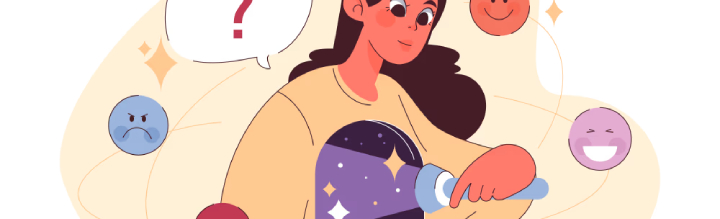
How often do you really listen to your emotions?
Not simply “I’m angry” or “I’m sad”, but:
Why am I feeling this way?
What happened just before this feeling appeared?
What might this emotion be trying to tell me?
Emotions are part of being human. They influence our relationships, decisions, behaviour and the way we experience the world.
Yet many of us were never taught how to understand them.
We may have learnt to hide them, suppress them, distract ourselves from them or judge ourselves for having them.
Perhaps you were told to “stop being so sensitive”, “calm down”, or “don’t cry”.
Over time, it can become easier to disconnect from what we’re feeling than to become curious about it.
Emotional awareness offers another approach.
Instead of asking how to get rid of difficult emotions, we can begin asking:
“What is happening within me right now?”
What Is Emotional Awareness?
Emotional awareness is the ability to recognise, name and understand your emotional experiences.
It means noticing not only what you’re feeling, but also becoming curious about what may be contributing to the feeling.
For example, you might say:
“I’m angry.”
With greater awareness, you might discover:
“I’m angry because I felt dismissed, and being dismissed brings up a strong sense that my needs don’t matter.”
Now you’re looking beneath the surface.
This doesn’t mean your interpretation is automatically correct.
It means you’ve created an opportunity to understand yourself more clearly.
Emotions Are Information, Not Instructions
One of the most useful things to understand about emotions is that they can provide information without necessarily providing instructions.
Fear may alert you to something that feels threatening.
Anger may indicate that you feel hurt, frustrated or that a boundary has been crossed.
Sadness can accompany loss, disappointment or loneliness.
Jealousy may reveal insecurity, desire or fear of losing something important.
Joy can highlight what feels meaningful and fulfilling.
But an emotion doesn’t automatically tell you what is objectively true.
Feeling rejected doesn’t necessarily mean you have been rejected.
Feeling threatened doesn’t necessarily mean you are in danger.
Feeling jealous doesn’t necessarily mean someone has done something wrong.
Your emotions are worth listening to, but they are not always reliable interpreters of reality.
This is where emotional awareness and discernment work together.
Naming an Emotion Can Change Your Relationship With It
Sometimes an emotion feels overwhelming because it remains vague.
You simply know:
“I feel terrible.”
Try becoming more specific.
Are you:
- Disappointed?
- Frustrated?
- Embarrassed?
- Lonely?
- Overwhelmed?
- Resentful?
- Anxious?
- Hurt?
- Jealous?
- Ashamed?
- Confused?
Finding a more precise word can create a little distance between you and the experience.
Instead of being completely immersed in the feeling, you are observing it.
You can say:
“I am experiencing anxiety.”
rather than:
“Everything is going wrong.”
That distinction can create space for reflection.
What Is Beneath the Emotion?
Sometimes the emotion we notice first isn’t the deepest feeling.
Anger, for example, can sometimes appear on top of hurt.
Irritation may be covering exhaustion.
Indifference may be protecting disappointment.
Perfectionism may be connected to fear.
Jealousy may be connected to insecurity or fear of losing connection.
This doesn’t mean every emotion has a hidden meaning.
Sometimes you’re simply tired, hungry, stressed or overwhelmed.
But when an emotional reaction seems particularly strong, it can be useful to become curious.
Ask:
“What else might be underneath this?”
Emotional Triggers Can Reveal Patterns
A trigger is something that produces a strong emotional response.
It could be a person’s tone of voice, being criticised, feeling ignored, uncertainty, rejection or losing control of a situation.
The important question isn’t simply:
“What triggered me?”
It is:
“Why did this affect me so strongly?”
Perhaps someone gives you constructive feedback and you immediately become defensive.
Maybe the feedback itself isn’t the whole story.
It could be touching an old belief:
“If I make a mistake, people will think I’m not good enough.”
Now the emotional response makes more sense.
This is where emotional awareness connects with the limiting beliefs we’ve explored previously.
The Body Often Notices Before the Mind
Emotions aren’t purely mental experiences.
They can be accompanied by physical sensations.
Your heart may beat faster.
Your shoulders may tense.
Your stomach may tighten.
Your breathing may become shallow.
You may feel warmth in your face or heaviness in your chest.
Learning to notice these sensations can help you recognise emotional states earlier.
Try pausing throughout the day and asking:
“What am I noticing in my body?”
Then ask:
“What emotion might be connected to this?”
Remember, physical sensations aren’t a perfect emotional detector. Stress, illness, tiredness and many other factors can produce similar sensations.
The purpose isn’t to interpret every bodily sensation.
It is simply to become more aware of the connection between body and emotional experience.
Don’t Make Every Emotion a Spiritual Message
There can be a temptation within spiritual circles to believe that every feeling contains a profound message.
Sometimes it does.
Sometimes you’re simply having a difficult day.
Emotional awareness doesn’t require us to turn every emotion into a spiritual lesson.
You can be angry because you are exhausted.
You can feel anxious because you’re facing uncertainty.
You can be sad because something painful happened.
Not every emotion needs to be transformed into something positive.
Sometimes it simply needs to be acknowledged.
There is wisdom in allowing an emotion to exist without immediately trying to explain it away.
Feeling an Emotion Doesn’t Mean Acting on It
This is an important part of emotional maturity.
You can feel anger without shouting.
You can feel jealousy without becoming controlling.
You can feel fear without automatically avoiding the situation.
You can feel hurt without immediately sending a message you might regret.
You can feel sadness without deciding that your entire life is unhappy.
The emotion is real.
The action is a choice.
This is where the pause becomes powerful.
Feel. Pause. Understand. Then choose.
A Simple Emotional Awareness Practice
The next time you experience a strong emotion, try this five-step process.
- Pause
Take a few slow breaths before reacting.
- Name it
Ask:
“What am I feeling?”
Try to be specific.
- Locate it
Where do you notice the emotion in your body?
- Explore it
Ask:
“What happened?”
“What am I telling myself about what happened?”
“What might I need right now?”
- Choose
Ask:
“What response would reflect the person I want to be?”
You don’t have to get the answer perfectly right.
The practice is about creating awareness.
What Do You Need?
Sometimes emotions point towards an unmet need.
You may need:
- Rest
- Connection
- Space
- Reassurance
- A boundary
- Support
- Understanding
- Time
- Safety
- Honesty
Instead of simply asking:
“How do I stop feeling this?”
try:
“What might I need?”
This can change the way you relate to yourself.
Perhaps your irritation is telling you that you’re exhausted.
Perhaps your resentment is showing you that you’ve been saying yes when you really wanted to say no.
Perhaps your loneliness is encouraging you to reconnect with someone.
The emotion isn’t necessarily giving you the complete answer, but it may be pointing towards something worth exploring.
Emotional Awareness and Relationships
Understanding your emotions can also transform the way you relate to other people.
When you become aware of your own triggers, you may become less likely to assume that someone else is responsible for everything you feel.
You can communicate more clearly:
Instead of:
“You never care about me.”
you might say:
“When that happened, I felt hurt and unimportant.”
The first statement attacks.
The second communicates an experience.
This doesn’t guarantee that the other person will respond well, but it gives the relationship a better opportunity for honest communication.
Meditation Can Help You Notice Emotions
Meditation isn’t about eliminating emotion.
In fact, sitting quietly can sometimes make emotions more noticeable.
You may suddenly become aware of sadness, frustration or anxiety that was hidden beneath the busyness of the day.
Rather than immediately pushing it away, you can practise observing it.
Notice the thoughts.
Notice the physical sensations.
Notice the urge to react.
Then return gently to the present moment.
This doesn’t mean meditation is suitable for every emotional difficulty, nor should it replace professional support when needed. For some people, difficult experiences can become more noticeable during periods of quiet reflection.
The goal is simply to develop greater awareness.
You Don’t Have to Believe Everything You Feel
Perhaps one of the most important lessons in emotional awareness is this:
Your feelings are real, but they are not always facts.
You can feel unwanted without being unwanted.
You can feel like a failure without being a failure.
You can feel unsafe without being in immediate danger.
You can feel certain that someone is judging you without actually knowing what they think.
This doesn’t mean dismissing your emotions.
It means holding them with curiosity.
You can say:
“This is what I’m feeling. Now let me discover what is true.”
That is emotional maturity.
Learning to Be With Yourself
Emotional awareness isn’t about becoming someone who never feels overwhelmed, angry, frightened or sad.
It is about becoming someone who can remain present with those experiences.
Instead of immediately running away from discomfort, you learn to sit with it.
Instead of judging yourself for having an emotion, you become curious about it.
Instead of allowing an emotion to control your behaviour, you create space to choose your response.
And gradually, you begin to realise that emotions are not enemies to defeat.
They are experiences to understand.
Some will pass quickly.
Some may require deeper exploration.
Some may reveal needs you’ve ignored.
Some may simply need to be felt.
And some may point towards important changes you need to make in your life.
The journey isn’t about becoming emotionally perfect.
It is about becoming more intimate with your own inner world.
Because when you learn to listen to yourself with honesty and compassion, you begin to recognise something important:
You don’t have to be afraid of what you feel.
You can feel it.
You can listen.
You can learn.
And then, with greater awareness, you can choose what comes next.

Author: Spirit Connection
Welcome to Spirit Connection, your online sanctuary for spiritual growth, enlightenment, and transformation. Founded by me, Glynis Brits - a gifted clairvoyant medium, spiritual teacher, and life coach, my mission is to guide you on a journey of self-discovery, healing, and deeper connection with the spiritual realm. Here at Spirit Connection, I publish daily articles on all things spiritual, esoteric, and metaphysical, offering insights and wisdom to support your awakening. Whether you're looking to connect with your spirit guides, enhance your intuition, or explore the mysteries of the universe, I provide the tools and knowledge to help you navigate your path. Through private readings, spiritual coaching, and personalized guidance, I empower individuals to embrace their divine potential and align with their soul’s purpose. Whether you're seeking clarity, healing, or a deeper understanding of your spiritual journey, I am here to support you every step of the way. Join my community and awaken to the magic of the unseen world. Your journey to enlightenment starts here.